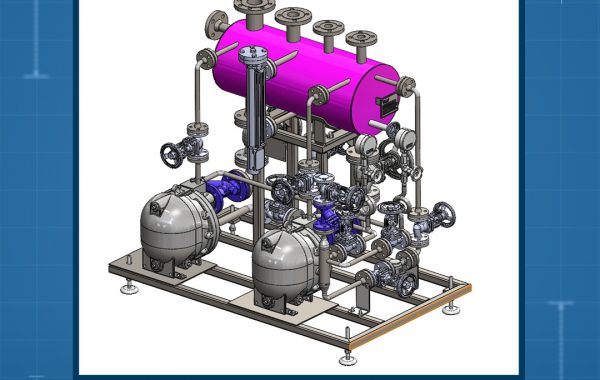
High Pressure Exchanger Design: Advanced Solutions for Safety, Efficiency and Durability
High pressure exchangers It is one of the most important equipment of heat transfer in industrial processes and is widely used in petrochemical, energy, food, pharmaceutical and refinery industries. They must have a structure that can withstand both high pressure and temperature while allowing heat transfer between liquids and gases. An efficient design not only improves energy efficiency but also ensures hardware integrity and operational safety.
As KHAN Engineering, FEA (Finite Element Analysis) , PV Elite We offer high pressure heat exchanger designs in accordance with international standards using engineering software such as. In this article, we discuss the design and analysis processes of high pressure exchangers, critical points to consider and the difference of KHAN Engineering.
1. What is a High Pressure Exchanger?
High pressure exchangers They are devices that transfer heat between two different fluids and generally operate under high pressure. These devices both ensure the efficient use of energy in industrial processes and contribute to the high performance of systems.
High Pressure Exchanger Types:
- Shell and Tube Heat Exchangers: It is the most common type. It is designed to withstand high pressure.
- Plate Heat Exchangers: It has a compact structure and provides effective heat transfer in smaller areas. However, high-pressure systems must be designed carefully.
- Cryogenic Exchangers: It is a type of pressure exchanger that operates at very low temperatures.
- Air to Air or Air to Liquid Exchangers: It is especially preferred in power plants and HVAC systems.
2. Challenges Encountered in High Pressure Heat Exchanger Design
The design of heat exchangers operating under high pressure requires special engineering approaches and detailed analysis. The following challenges are the most important to consider in the design process:
a) Pressure Resistance
Under high pressure conditions, a detailed stress analysis must be performed to prevent deformation, fatigue or cracking anywhere in the exchanger.
b) Thermal Stress
The thermal difference between two fluids operating at different temperatures can test the material durability of the heat exchanger. Proper material selection and thermal expansion analysis are required.
c) Flow Behavior
Velocities of fluids, turbulence levels and pressure-based flow resistance have a direct impact on the efficiency of the exchanger. Hydraulic calculations should be considered as a priority.
d) Corrosion and Erosion Risk
Materials that are resistant to the risk of corrosion and abrasion should be used in heat exchangers that work with chemical substances.
e) sealing
The risk of leakage is always a critical problem in systems operating at high pressure. Flanges, gaskets and welded connections require special designs and analyses.
3. High Pressure Exchanger Design Process
KHAN Engineering, high pressure exchangers It carries out its design with the highest level of engineering. Here is the design and analysis process we followed:
a) Project Inception Phase and Technical Requirements
- The desired pressure and temperature values are determined.
- Fluid types (gas or liquid) and physical properties are evaluated.
- Environmental conditions and working patterns are examined.
b) Compliance with Codes and Standards
- Compliance with international standards such as ASME Section VIII, EN 13445 and TEMA is ensured.
- Safety limits set by standards for high pressure and temperature applications are taken into account.
c) FEA (Finite Element Analysis) and Thermal Analysis
- Stress distribution, deformation and stress concentration points are analyzed using FEA.
- With thermal stress analysis, it is simulated how the material will behave in different temperature regimes.
d) Fluid and Hydraulic Design
- The appropriate pipe diameter and geometry are determined by taking into account the flow rate, temperatures and pressures of the fluid.
- Simulations are applied to maximize heat transfer by minimizing flow turbulence.
e) Material Selection
- Material durability and corrosion resistance are analyzed according to operational requirements.
- Precision materials such as stainless steel, alloy steels or Inconel are selected.
f) Sealing System Design
- Flanges, gaskets and assembly methods are analyzed to ensure complete sealing.
4. Standards Used in High Pressure Exchangers
As KHAN Engineering, we ensure full adherence to the following international standards in our projects:
a) ASME Section VIII
It is America's pressure vessel design standard. The compressive strength in heat exchangers determines material selection and sealing levels.
b) EN 13445
European pressure vessel standards contain detailed directives to ensure the thermal and mechanical durability of heat exchangers.
c) TEMA (Tubular Exchanger Manufacturers Association)
It is an international standard that defines heat exchanger design and performance requirements.
d) API 660
It determines the design principles of fixed tube heat exchangers used in refineries.
5. KHAN Engineering's Difference in High Pressure Heat Exchanger Design
KHAN Engineering makes a difference in heat exchanger design with its sectoral experience and technological infrastructure. Here are our features that make us stand out:
a) Expert Staff
Our engineering team specializes in ASME, EN and TEMA standards and offers customized solutions for each project.
b) Advanced Engineering Tools
PV Elite , SolidWorks Simulation ve ANSYS We perform high-precision analyzes and designs using software such as.
c) Efficiency and Cost Optimization
With the right design, we aim to both increase energy efficiency and reduce your production costs.
d) International Experience
We bring our sectoral experiences from Türkiye and Germany to the field for your international projects.
6. KHAN Engineering is by your side for a safe and efficient heat exchanger
Correct engineering and innovative solutions allow you to be one step ahead in high pressure heat exchanger design. By working with KHAN Engineering, you can have reliable and energy efficient equipment that complies with international standards.
Contact us for your next project and discover our solutions tailored to your engineering needs.
Contact Information:
- 📧 Email: info@khan.engineering
- 🌐 Website: www.khan.engineering
- 📍 Germany Office: Friedrichstraße 15, 70174 Stuttgart, Almanya
- 📍 Türkiye Office: Yeni Mah. Şimşir St. No:9/4, Pendik, Istanbul
Turkish:
High Pressure Exchanger Design, Shell and Tube Exchanger Analysis, ASME Section VIII Standards, EN 13445 Design, Exchanger Analysis with FEA, PV Elite Exchanger Simulation, Cryogenic Exchanger Design, Thermal Stress Analysis, Corrosion Resistant Materials, KHAN Engineering, Refinery and Energy Exchanger Design ,
English:
High Pressure Heat Exchanger Design, Shell and Tube Heat Exchanger Analysis, ASME Section VIII Standards, EN 13445 Heat Exchanger Design, FEA for Heat Exchangers, PV Elite Simulation, Cryogenic Heat Exchanger Design, Thermal Stress Analysis, Corrosion Resistant Materials, KHAN Engineering Services, Refinery and Energy Heat Exchanger,
German:
High Pressure Heat Exchanger Design, Shell and Tube Heat Exchanger Analysis, ASME Section VIII Standards, EN 13445 Heat Exchanger Design, FEA Heat Exchanger Analysis, PV Elite Simulation, Cryogenic Heat Exchanger, Thermal Stress Analysis, Corrosion Resistant Materials, KHAN Engineering Services, Refinery and Energy Heat Exchangers,