
Prismatic Vacuum Tank Analysis: Engineering Solution of Precision, Safety and Durability
Prismatic vacuum tanks They are specially designed equipment used for the storage, transportation or processing of liquid or gaseous substances under low pressure in industrial processes. Compared to other pressure and vacuum tanks, it offers a compact structure thanks to its prismatic form and provides optimized solutions for storage or production areas. However, when designing and analyzing these tanks, the extra loads imposed by vacuum conditions and the special design requirements caused by the prismatic shape must be taken into account.
As KHAN Engineering, FEA (Finite Element Analysis) By using and advanced engineering software, we provide reliable and efficient design of prismatic vacuum tanks in full compliance with international standards. In this article, we will discuss the analysis process of prismatic vacuum tanks, the critical factors to consider, and KHAN Engineering's unique expertise in this field.
1. What is a Prismatic Vacuum Tank and Why is it Preferred?
Prismatic vacuum tanks They are equipment designed in rectangular or square prism form and operate under low pressure (vacuum). It is preferred in corrosive environments, cryogenic processes, liquid gas storage or sensitive processes.
Advantages of Prismatic Vacuum Tanks:
- Space Optimization: Thanks to its prismatic form, it leaves less free space than standard cylindrical tanks and increases storage capacity.
- Portability: The compact and modular structure of the tank provides convenience, especially in mobile applications.
- Multifunctionality: It can be used versatilely for logistics, storage and process operations.
- Durability in Vacuum Condition: A well-designed prismatic tank provides resistance to deformation or collapse under vacuum.
These advantages extend their usage areas to sectors such as energy, chemicals, pharmaceuticals, defense industry and food and beverage industry.
2. Challenges of Prismatic Vacuum Tanks
The design and analysis of prismatic tanks operating under vacuum conditions poses many engineering challenges. Prismatic design requires careful engineering as it is prone to high stress zones and bending effects.
Challenges Encountered:
- Preventing Collapse: In vacuum conditions, there is a high risk of slippage or collapse caused by external loads due to the lack of internal pressure of the tank.
- Stress Concentrations: In prismatic geometry, stress concentrations may occur at right-angled junctions.
- Material Efficiency: While increasing the tank's strength, a cost-effective material selection should be made.
- Resource Links: Risks of leakage in welded areas of vacuum tanks should be taken into account.
- Thermal Effects and Vacuum Conditions: Thermal expansion analysis becomes especially critical in a cryogenic application.
3. Prismatic Vacuum Tank Analysis Process
KHAN Engineering, prismatic vacuum tanks It applies a holistic analysis process to ensure reliable operation. Here are the topics we covered during the design and analysis process:
a) Geometric and Load Calculations
- Analysis of external loads (atmospheric pressure, dead loads) occurring due to the prismatic shape is performed.
- The stability of the tank is checked under vacuum conditions.
b) Material Selection and Thickness Optimization
- Materials suitable for low pressure working conditions and corrosion are selected.
- The thickness of the tank walls is optimized, thus avoiding the use of unnecessary materials.
c) FEA (Finite Element Analysis)
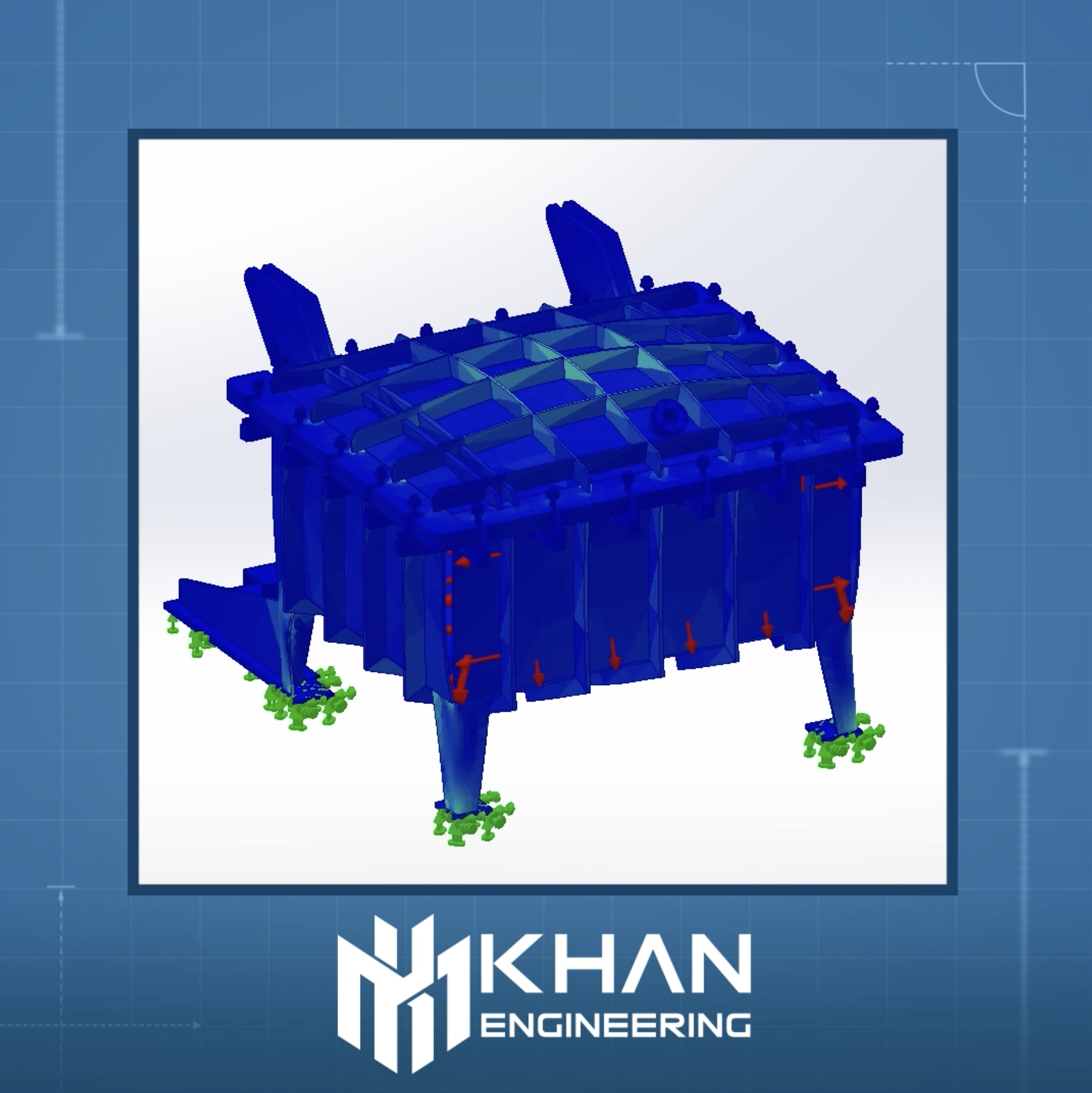
- Stress, deformation and stability analysis in different parts of the tank is carried out in detail.
- Stress concentrations occurring in corners and welded joints are analyzed and reinforcements are designed to increase strength.
- An analysis is made to determine whether the tank will experience any collapse or deformation in its section.
d) Fatigue and Thermal Analysis
- How thermal expansion affects the structure is examined. Especially in cryogenic processes, the thermal resistance of the tank is measured.
- The fatigue durability of the tank under long-term constant load effects is simulated.
e) Welding Design and Leakage Analysis
- Each joint of the prismatic vacuum tank is made suitable for sealing conditions using welding techniques.
- The resistance of welded joints to deformation is checked under vacuum.
4. Standards and Engineering Approaches Used
KHAN Engineering complies with the following standards during the design and analysis of prismatic vacuum tanks:
a) ASME Section VIII
It provides international engineering criteria for material strength, stress limits and structural stability of tanks operating under vacuum.
b) EN 13445
The European pressure vessel standard contains comprehensive rules, including strength analysis and design principles under vacuum conditions.
c) API Standards
API 650 and API 620 provide guidance for vacuum durability and fasteners, particularly of large storage tanks.
d) ISO 9001 Quality Management
ISO management systems are applied to ensure the highest quality standards in production and design processes.
5. KHAN Engineering's Difference in Prismatic Vacuum Tank Design
KHAN Engineering As an industry-leading design and engineering company, it develops high-strength, economical and functional solutions for your projects. Here are the features that make us different:
a) Our Expert Team
Our engineers, who have international experience in vacuum tanks, offer a unique solution to every project.
b) Engineering Tools
ANSYS , SolidWorks Simulation , PV Elite We perform high-precision analyzes using software such as.
c) Compliance with Standards
Our design and analysis processes are fully compliant with globally accepted standards (ASME, EN and API).
d) Cost Efficiency
While we reduce costs by preventing the use of unnecessary materials in tank design, we never compromise on safety.
e) Local and International Experience
With our operations in Türkiye and Germany, we offer superior engineering solutions for local and global projects.
6. KHAN Engineering for Reliable Prismatic Vacuum Tank Solutions
Special designs that operate under vacuum can only be successful with engineering expertise and meticulous analysis. As KHAN Engineering, we are here to make your projects safe, efficient and cost-effective.
Contact us for your next project and From our prismatic vacuum tank analysis take advantage!
Contact Information:
- 📧 Email: info@khan.engineering
- 🌐 Website: www.khan.engineering
- 📍 Germany Office: Friedrichstraße 15, 70174 Stuttgart, Almanya
- 📍 Türkiye Office: Yeni Mah. Şimşir St. No:9/4, Pendik, Istanbul
Turkish:
Prismatic Vacuum Tank Analysis, Vacuum Tank Design, FEA Vacuum Tank Analysis, Pressure Vessel Standard, ASME Vacuum Design, EN 13445 Analysis, API 620 Vacuum Tank Design, KHAN Engineering Services, Thermal Stress Analysis, Welded Connection Analysis, Leak Tightness Tests,
English:
Prismatic Vacuum Tank Analysis, Vacuum Tank Design, FEA Vacuum Tank Simulation, Pressure Vessel Standards, ASME Vacuum Design, EN 13445 Compliance Tanks, API 620 Vacuum Tank Design, KHAN Engineering Services, Thermal Stress Simulation, Weld Joint Analysis,
German:
Prismatic Vacuum Tank Analysis, Vacuum Tank Analysis, FEA Vacuum Tank Simulation, Pressure Vessel Standards, ASME Vacuum Design, EN 13445 Compliant Tanks, API 620 Vacuum Tank Design, KHAN Engineering Services, Thermal Stress Analysis, Weld Joint Analysis,